Phone: 0086-15860783774 Email: contact@displaystone.com

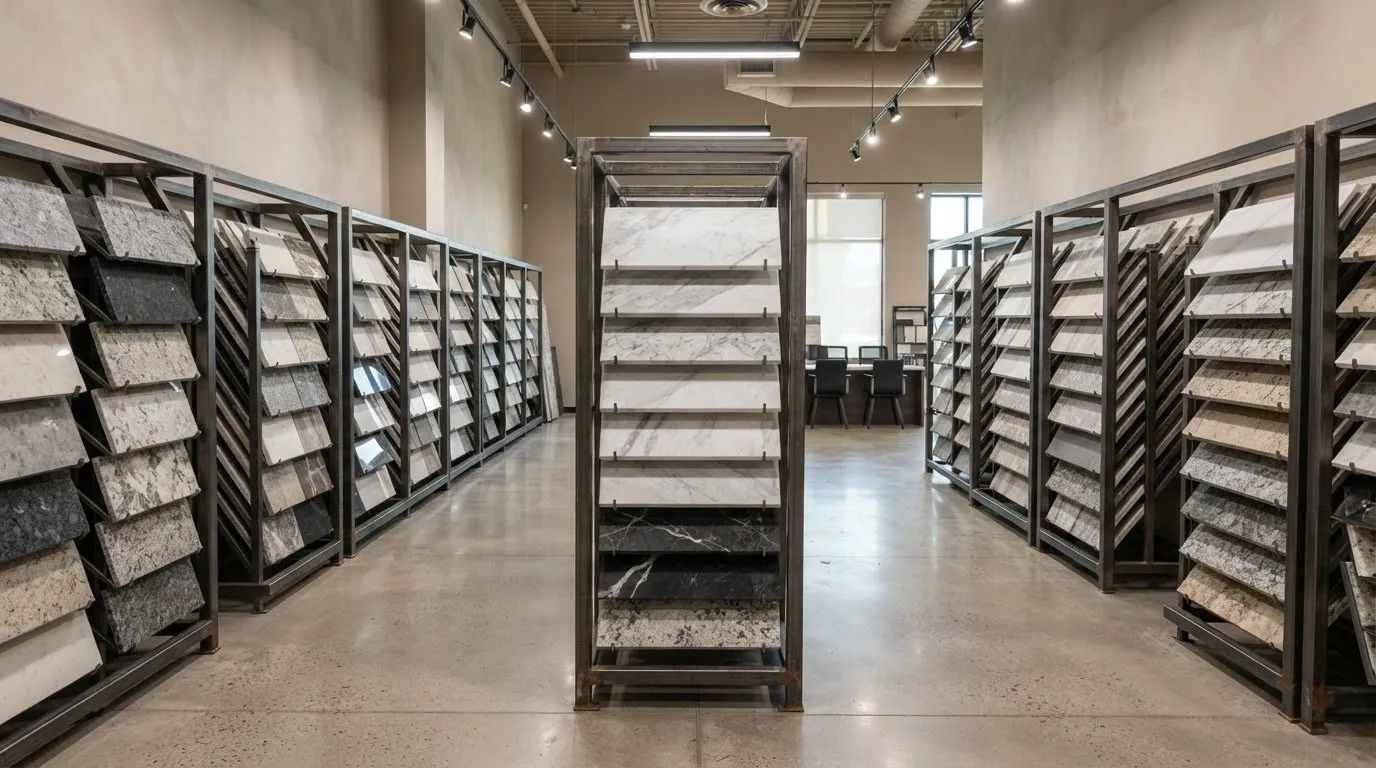
How to choose a stone display rack: do the slab-weight math first, because one 20 mm granite slab at 3000 × 1500 mm already weighs about 243 kg and a rack holding twenty of them carries roughly 4.9 tonnes. Then match the rack type to your floor plan, compare the real footprint and capacity figures, and finally check steel thickness, base width and anchoring.
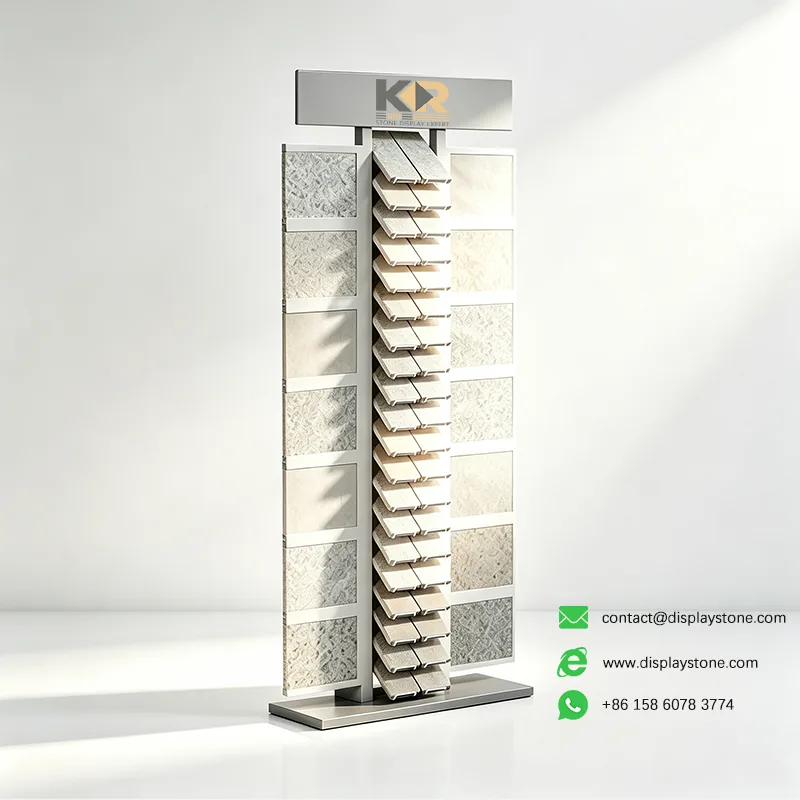
This guide walks through all four steps with the numbers we use on our own line. Every figure below comes from our own production line, so treat this as a stone sample rack buying guide built on load numbers rather than adjectives. For the full range behind these numbers, see our complete stone display rack guide.
Table of Contents
- How to Choose a Stone Display Rack: The Four Steps
- Step 1: Do the Slab Math Before You Shop
- Step 2: Match the Rack Type to the Job
- Step 3: Compare the Real Numbers
- Step 4: Check Build Quality and Safety
- Space and ROI: How Many Racks Fit Your Floor?
- Lighting and Color Accuracy
- How to Choose a Stone Display Rack for Your Showroom Type
- Common Mistakes to Avoid
- A Note for Importers and OEM Buyers
- Frequently Asked Questions
How to Choose a Stone Display Rack: The Four Steps
The four steps run in a fixed order: slab math, type selection, real-number comparison, then build-quality checks. Each one narrows the next, because weight sets the steel you need, size sets the slot depth, and only then does style matter. Knowing how to choose a stone display rack in this order keeps the decision factual instead of decorative.
Step 1: Do the Slab Math Before You Shop
Start with weight, not looks. Weight equals density times volume, and the three densities that matter are granite at about 2.70 g/cm³, marble at 2.56 and quartz at 2.40. For a common 3000 × 1500 × 20 mm slab, that is 0.09 m³:
- Granite: 0.09 m³ × 2700 kg = 243 kg
- Marble: 0.09 m³ × 2560 kg = 230 kg
- Quartz: 0.09 m³ × 2400 kg = 216 kg
Next, know your sizes. Standard slabs run 2400 × 1200 mm and 3000 × 1500 mm, and jumbo quartz often reaches 3200 × 1600 mm. Measure your tallest and widest slab first, then match slot height and depth to the largest piece you sell. A stone slab display rack that is sized to your smallest board will fail on your largest one.
Step 2: Match the Rack Type to the Job
Five formats cover most floors, and each solves a different problem:
- Vertical rack — 1952 × 472 × 452 mm, 0.21 m², 15–20 full slabs. Best for narrow aisles and full slabs.
- Tower — 2070 × 381 × 640 mm, 0.24 m², 24–28 samples. Best as a center island customers walk around.
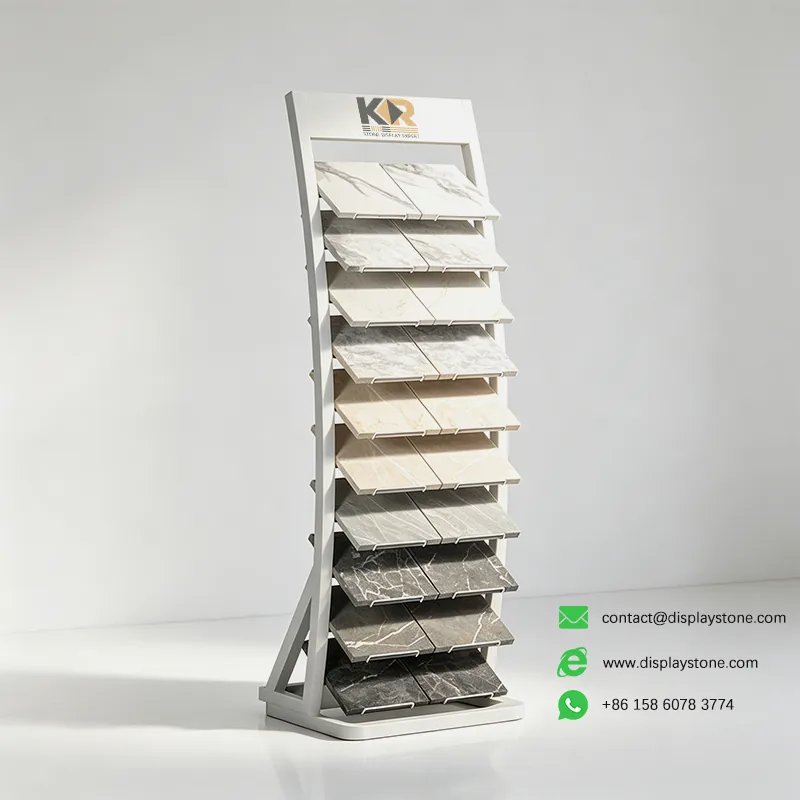
- Slanted rack — 1980 × 480 × 460 mm, 0.22 m², 28 samples. Best where color and veining drive the sale.
- Sample rack — A-frame multi-tier, 26 finishes on wire hooks. Best for cut samples alongside a slab unit.
- Sample book — 32 pockets, portable. Best for off-site meetings.
Our stone display rack types comparison extends this to nine formats with dimensions side by side.
Step 3: Compare the Real Numbers
| Type | Footprint | Capacity | Best for |
|---|---|---|---|
| Vertical rack | 0.21 m² | 15–20 slabs | Narrow aisles, full slabs |
| Tower | 0.24 m² | 24–28 samples | Center island, browsing |
| Slanted rack | 0.22 m² | 28 samples | Eye-level, design showrooms |
| Sample rack | Compact | 26 finishes | Cut samples, finishes |
| Sample book | None | 32 pockets | Off-site meetings |
A heavy stone display stand is not defined by a marketing word. It is defined by whether the frame carries your load without flexing, so compare rated capacity against your own slab weight rather than against another rack’s brochure. In practice, load capacity decides how to choose a stone display rack that still looks right in year three.
Step 4: Check Build Quality and Safety
- Steel thickness: choose at least 2.0 mm for full slabs; thin tube bends under load.
- Base and anchor: a wide base plate plus a wall anchor stops tipping.
- Coating: powder coat or baked paint resists chips and rust better than ordinary paint.
- Welds: continuous welds beat spot welds for long-term strength.
- Load rating: an honest rating beats a vague “heavy duty” claim.
Space and ROI: How Many Racks Fit Your Floor?
A slab laid flat needs about 4.5 m² of floor, while a vertical rack shows 15–20 slabs in 0.21 m² — roughly 20–50 times more space-efficient. In a 40 m² showroom that lets you display 150–300 slabs along the walls and still keep the center open. The right rack therefore lowers rent per displayed sample and shortens the time a buyer spends deciding. For many buyers this space math is the turning point in how to choose a stone display rack.
Lighting and Color Accuracy
Stone sells on color. Use LEDs with a CRI of 90 or higher and a temperature near 4000–5000K, aimed about 30 degrees to the face. Inclined racks present the surface at a natural angle and cut glare, so customers see real veining instead of a reflection. For marble specifically, a tilt near 15–20 degrees shows the vein at natural standing height; see our marble display rack selection notes for how hardness changes the choice.
How to Choose a Stone Display Rack for Your Showroom Type
- Distributor or importer: combine vertical racks, a tower and a sample book to show volume and carry a catalog to meetings.
- Fabricator: place vertical slot racks near the cutting area for daily slab handling and fast pickup.
- Designer showroom: lead with slanted and sample racks, where looks drive the sale.
Common Mistakes to Avoid
- Buying on price alone — a weak frame bends and scratches stone.
- Ignoring slab weight — overloaded slots are a safety risk.
- Mixing too many styles — visual clutter hurts the brand.
- Skipping wall anchors — tall racks can tip.
- Forgetting future growth — leave room to add samples.
- Using flat stacking — it wastes floor and hides inventory.
A Note for Importers and OEM Buyers
We build to your gauge, size, finish and branding, and we help plan container loads so a full range ships efficiently. Sample lead time is 1–2 weeks and production runs 3–4 weeks after drawing approval. Overseas buyers often ask how to choose a stone display rack that also ships efficiently, and the answer is to fix slot count and knock-down packing before you fix the finish.
For stone care and showroom handling standards we follow the guidance published by KBIS exhibitors and the Natural Stone Institute; request a quote with your floor plan.
Frequently Asked Questions
How much does a 20 mm granite slab weigh?
About 243 kg at 3000 × 1500 mm. Marble is close at 230 kg and quartz is 216 kg for the same size, because granite is denser at about 2.70 g/cm³ versus 2.56 and 2.40.
What steel thickness do I need for granite slabs?
Use at least 2.0 mm steel for full granite slabs. A single 20 mm slab weighs about 243 kg, so the frame must carry several tonnes without flexing.
Vertical or tower — which saves more floor space?
The tower is densest, showing 24–28 samples in 0.24 m². The vertical rack shows 15–20 slabs in 0.21 m². Pick the tower for a center island and the vertical rack for walls. If your aisle is tight, this comparison settles how to choose a stone display rack for your floor.
How do I stop a display rack from tipping?
Anchor it to the wall, use a wide base plate, load slots evenly, and train staff to pull from the center first. Never overload past the rated count.
Can I order custom or branded racks?
Yes. As the manufacturer we build to your gauge, size, finish and logo, and we plan container loads for overseas buyers. OEM branding runs from 50 units on several models.