Phone: 0086-15860783774 Email: contact@displaystone.com


Stone display rack is the umbrella term for one specific job: holding marble, granite, quartz and tile samples upright or at an angle so buyers can compare them in one place. It is not shelving. A single 20 mm granite slab at 3000 × 1500 mm weighs about 243 kg, so frame steel, base width and wall anchoring decide whether the unit is safe. This guide covers the main types, the weight math behind every frame, and the checks that separate a rack that sells from one that bends.
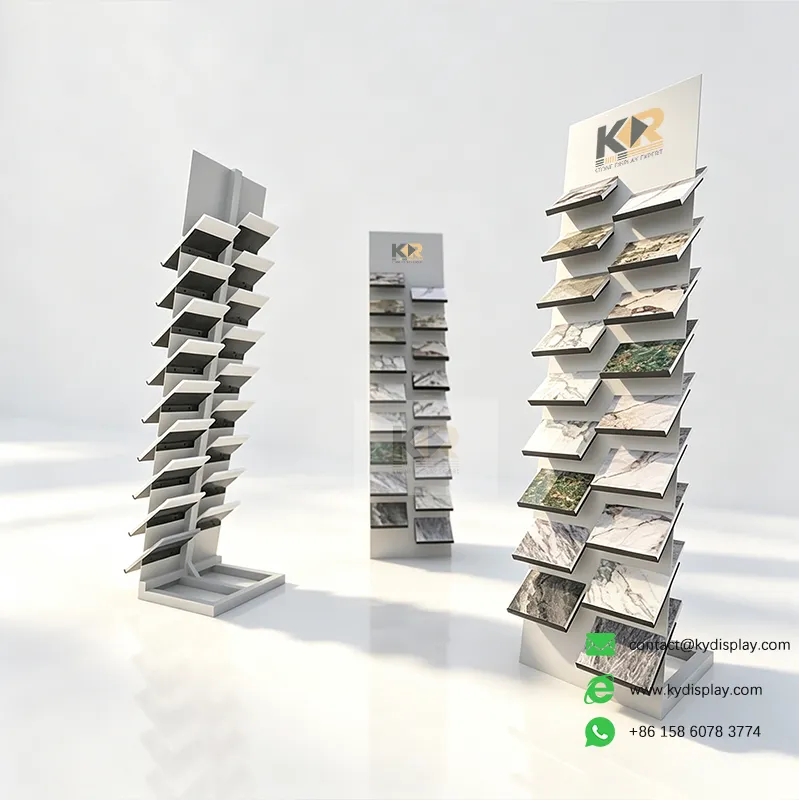
KERRY DISPLAY builds these racks in a 10,000 m² facility and has delivered more than 100 showroom projects worldwide. The stone-handling and care standards referenced below follow the guidance published by the Natural Stone Institute.
Table of Contents
- What a Stone Display Rack Actually Does
- Stone Display Rack Weight: The Math Behind Every Frame
- Stone Display Rack Types at a Glance
- How to Choose a Stone Display Rack in Four Steps
- Match the Stone Display Rack to Marble, Quartzite and Granite
- Layout, Lighting and Space ROI
- Build Quality and Safety Checklist
- Custom Sizing, Branding and OEM
- Frequently Asked Questions
What a Stone Display Rack Actually Does
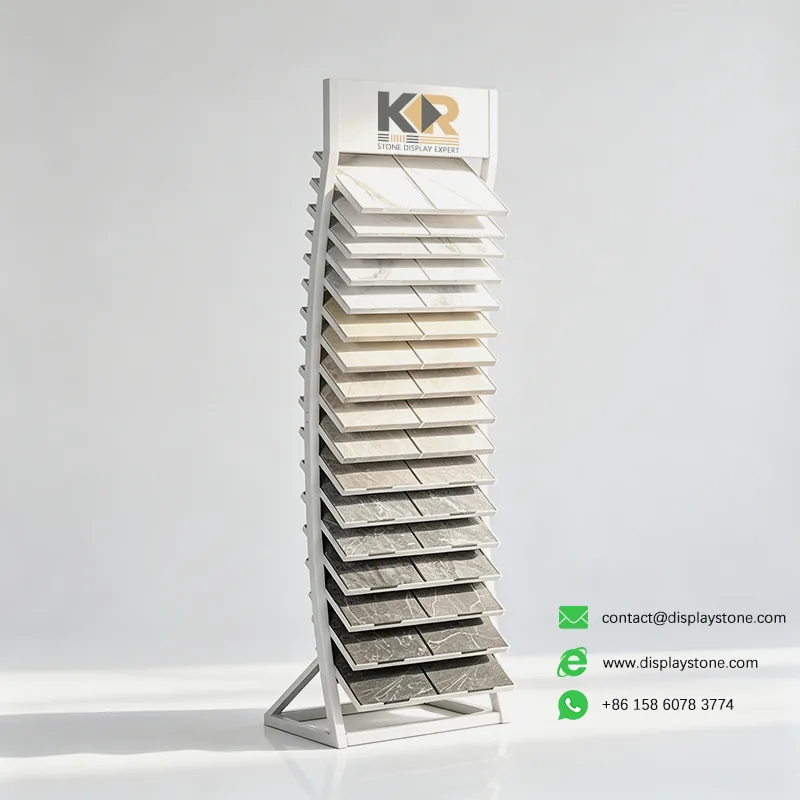
A stone display rack solves three problems at once. First, it turns floor area into vertical display area, because a slab laid flat needs about 4.5 m² while a vertical unit shows 15–20 slabs in 0.21 m². Second, it presents the face of each board at a readable angle, so buyers judge color and veining without lifting anything. Third, it protects expensive material: slots, lips and pads keep heavy boards from sliding or chipping during daily handling.
Showrooms that skip this step pay for it twice — once in rent per displayed sample, and once in damaged stock.
Stone Display Rack Weight: The Math Behind Every Frame
Weight equals density times volume. On our line we work with three densities: granite at about 2.70 g/cm³, marble at 2.56, and quartz at 2.40. For a common 3000 × 1500 × 20 mm slab, that is 0.09 m³, which gives:
- Granite: 0.09 m³ × 2700 kg = 243 kg
- Marble: 0.09 m³ × 2560 kg = 230 kg
- Quartz: 0.09 m³ × 2400 kg = 216 kg
So a stone display rack loaded with 20 granite slabs carries roughly 4.9 tonnes at once. That is why we specify 2.0 mm steel for full slabs, and why base width matters more than a low sticker price. Most showrooms also mix formats: standard slabs run 2400 × 1200 mm and 3000 × 1500 mm, while jumbo quartz often reaches 3200 × 1600 mm. Measure your tallest and widest slab first, then match slot height and depth to the largest piece you sell.
Stone Display Rack Types at a Glance
Five formats cover almost every floor plan. These are real figures from our own line.
| Type | Footprint | Capacity | Best for |
|---|---|---|---|
| Vertical rack | 0.21 m² | 15–20 slabs | Narrow aisles, full slabs |
| Tower | 0.24 m² | 24–28 samples | Center island, browsing |
| Slanted rack | 0.22 m² | 28 samples | Eye-level, design showrooms |
| Sample rack | Compact | 26 finishes | Cut samples, finishes |
| Sample book | None | 32 pockets | Off-site meetings |
Each style is covered in detail in our stone display rack types comparison, which lists nine formats with dimensions and capacity side by side. The compact unit works as a stone sample rack for cut finishes beside a slab rack.
How to Choose a Stone Display Rack in Four Steps
The short version: do the slab math, match the type to the job, compare the real numbers, then check build quality and anchoring. Our four-step stone rack selection guide walks through each step with a worked example and a space-and-ROI calculation you can copy.
Match the Stone Display Rack to Marble, Quartzite and Granite
Hardness decides how gently a rack must treat a stone, and weight decides how strong it must be. On the Mohs scale marble sits around 3–5, quartzite near 7, and granite about 6–7. In practice:
- Marble is a recrystallized limestone and the most delicate stone you will display, so a marble display rack must treat it gently. Use EPDM rubber or felt pads so hard metal cannot chip a polished face, and set a tilt near 15–20 degrees so the vein reads at natural standing height. Marble is calcium carbonate, so it etches on contact with acid — keep citrus and acidic cleaners away from the rack.
- Quartzite is sandstone fused by heat and pressure, so it is far harder and denser. It needs thicker steel and a lower center of gravity; firm dividers and light clamping are safe here.
- Granite is dense and heavy but uniform, so a granite display rack can use simple dividers. Keep the heaviest boards on the lowest, strongest tiers.
Our marble vs quartzite display rack comparison maps each stone to the fixture that suits it, and the travertine sample display guide covers the warm-toned porous stones that need the same gentle handling as marble.
Layout, Lighting and Space ROI
A good stone display rack pays its own rent. A slab laid flat needs about 4.5 m² of floor; a vertical unit shows 15–20 slabs in 0.21 m², roughly 20–50 times more space-efficient. In a 40 m² showroom that difference lets you display 150–300 slabs along the walls while keeping the center open for customers.
Light decides whether the stone looks true. Use LEDs with a CRI of 90 or higher and a temperature near 4000–5000K, and aim them about 30 degrees to the face rather than straight down. Inclined racks cut glare, so buyers see veining instead of their own reflection.
Build Quality and Safety Checklist
- Steel thickness: at least 2.0 mm for full slabs — thin tube bends under load.
- Base and anchor: a wide base plate plus a wall anchor stops tipping.
- Coating: powder coat or baked paint resists chips and rust better than ordinary paint.
- Welds: continuous welds beat spot welds for long-term strength.
- Load rating: an honest rated capacity beats a vague “heavy duty” claim.
Custom Sizing, Branding and OEM
Every stone display stand on this page is built to order. We adjust height, slot count and spacing to your sample size, match any RAL color, and add laser-etched or printed branding to the header panel.
OEM branding runs from 50 units on several models and 100 units on others; sample lead time is 1–2 weeks and production runs 3–4 weeks after drawing approval. Browse the full vertical marble display stand and the wider stone display rack category for current specifications, or send us your floor plan for a layout drawing and quote.
Frequently Asked Questions
How much weight does a stone display rack need to hold?
Start from your heaviest board. A 20 mm granite slab at 3000 × 1500 mm weighs about 243 kg, and a rack holding 20 of them carries roughly 4.9 tonnes. Size the frame to the heaviest stone you will actually place on it, not to the lightest.
What steel thickness should I specify?
At least 2.0 mm for full-size slabs. Thinner tube may look similar on day one, but it bends under sustained load and the slots go out of alignment.
Which saves more floor space, a vertical rack or a tower?
The tower is denser, showing 24–28 samples in 0.24 m², while the vertical rack shows 15–20 slabs in 0.21 m². Pick the tower for a center island that customers walk around, and the vertical rack for walls and narrow aisles.
Do I need to anchor the rack to the wall?
For tall units, yes — use a wide base plate plus a wall anchor. Some slim towers ship with a weighted base that stays steady when loaded evenly; check the rating on the specific model.
Can one rack hold marble, quartzite and granite together?
Yes, but size every tier to the heaviest stone and fit rubber or felt pads so the softer marble still rests safely. Better still, group samples by stone type and give each group a rack built for its behavior.
What lighting gives the truest stone color?
LEDs with a CRI of 90 or higher at about 4000–5000K, aimed roughly 30 degrees to the face. Straight-down spots flatten marble veining and hide depth in quartzite.