Phone: 0086-15860783774 Email: contact@displaystone.com

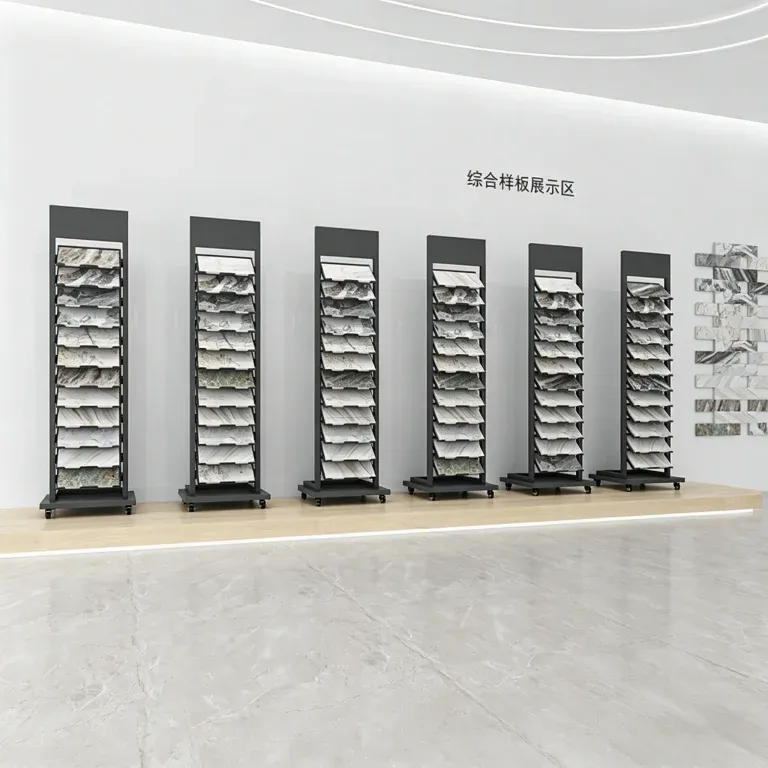
Stone display rack types differ in one measurable way: how much stone they hold per square meter of floor, and how heavy that stone is allowed to be. Below are nine formats we build, with the real dimensions and capacity of each, so you can match a frame to your slab size instead of guessing from a photo.
Table of Contents
- How to Read These Stone Display Rack Types
- 1. Vertical Stone Display Rack
- 2. Vertical Marble Display Stand
- 3. Stone Display Tower
- 4. Slanted Stone Display Rack
- 5. Slanted Vertical Stone Display Rack, 1800 mm
- 6. A-Frame Stone Display Tower
- 7. Narrow Stone Sample Tower
- 8. Stone Sample Display Rack
- 9. Tabletop Stone Display Rack
- Comparison Table
- Also Available: Rotating, Leaning, Curved and High-Capacity Formats
- Which Stone Display Rack Type Should You Pick?
- Frequently Asked Questions
How to Read These Stone Display Rack Types
Stone store display racks are usually grouped by how the sample sits: on edge, at a lean, or flat on a shelf. Two numbers then decide everything. The first is footprint — the floor area the unit occupies. The second is capacity, which depends on your sample size, so treat counts as typical rather than fixed. Where a figure depends on board thickness or tier spacing, we say so rather than print a number we cannot stand behind.
1. Vertical Stone Display Rack
The vertical stone display rack stores slabs on edge in slim steel slots. It stands 1952 mm tall, 472 mm wide and 452 mm deep, so its footprint is only 0.21 m², and the 2.0 mm steel frame holds 15–20 full slabs. Choose it for narrow aisles and high-traffic walls where full slabs must be seen but floor space is tight. It is the default choice among stone display rack types when full slabs must face the aisle.
2. Vertical Marble Display Stand
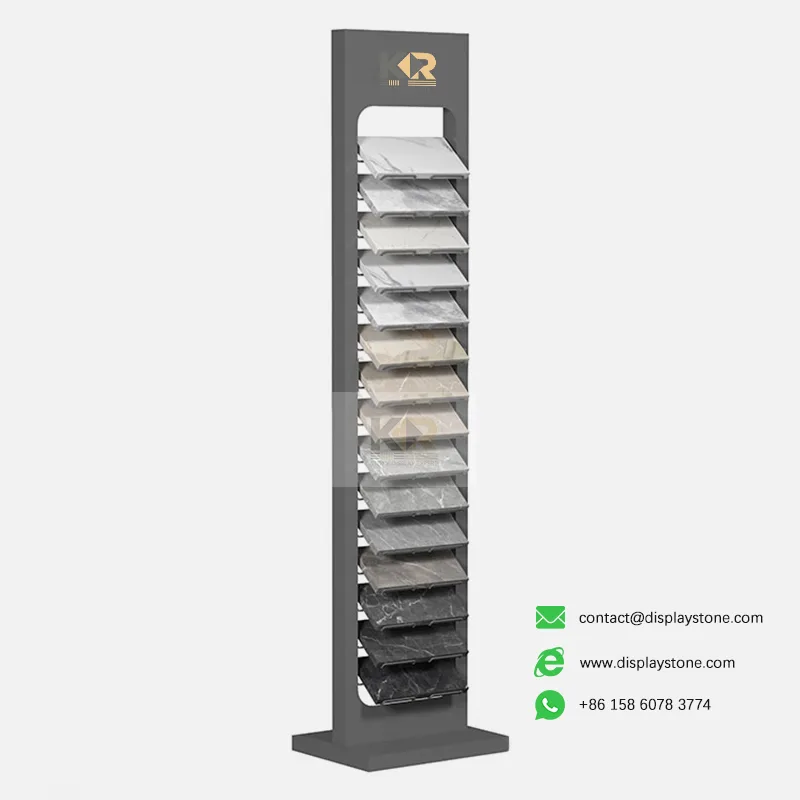
Our vertical marble display stand is a floor-standing unit at 1992 × 575 × 450 mm (H × W × D), built from high-strength cold-rolled seamless steel with an electrostatic powder coat. Slot count is customizable, the reinforced base is designed for zero wobble under heavy stone, and branding can be printed, engraved or fitted as a metal plate. Standard colors are matte black, white and grey, with full RAL matching available.
3. Stone Display Tower
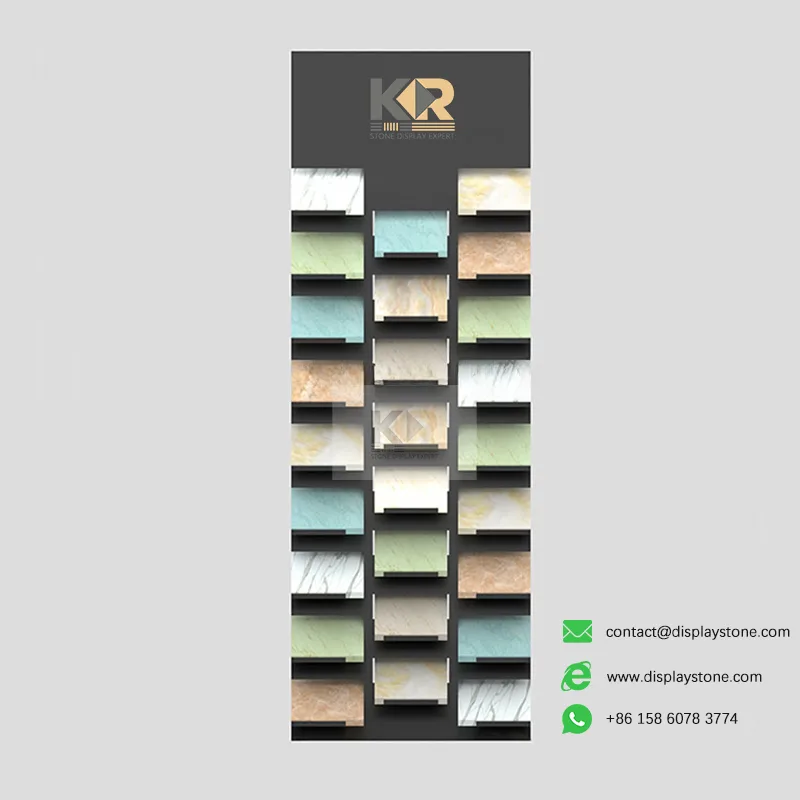
The stone display tower is a double-sided wire-hook unit measuring 2070 × 381 × 640 mm. It holds 24–28 samples in just 0.24 m², and customers can circle it without backtracking, which makes it the densest option here and the natural choice for a center island.
4. Slanted Stone Display Rack
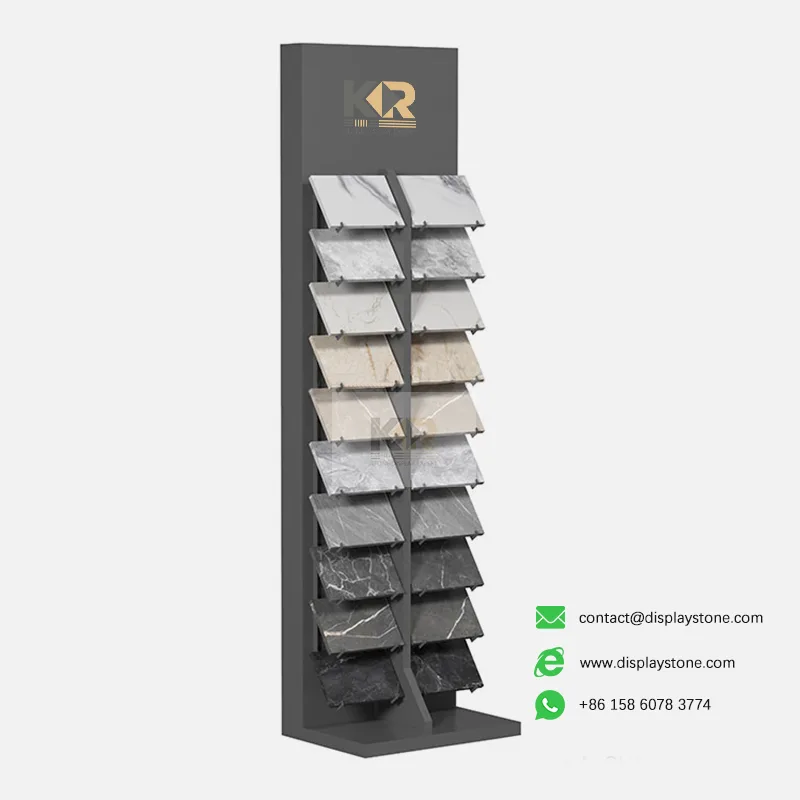
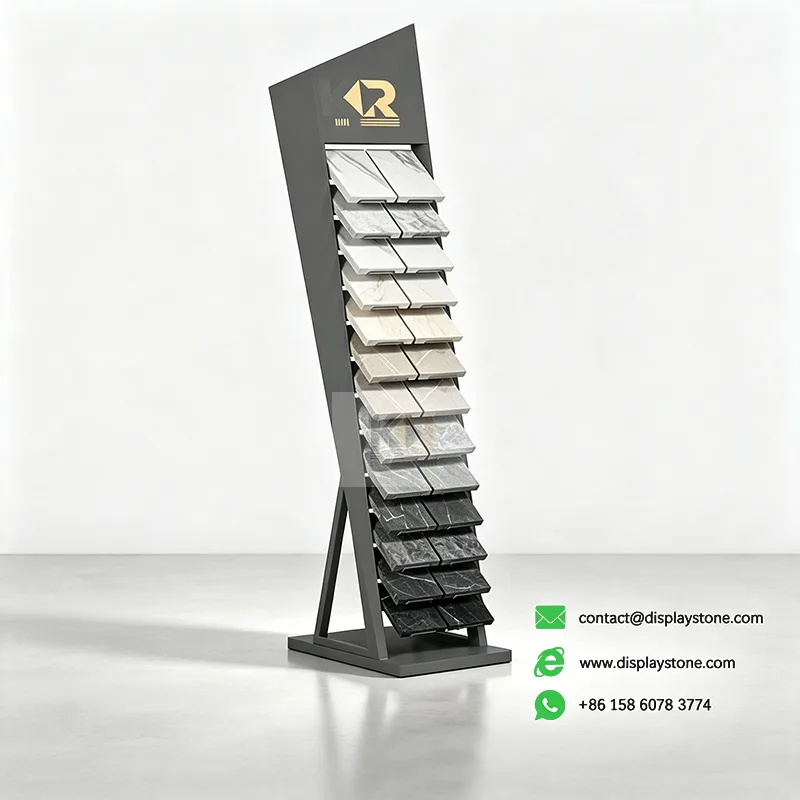
A slanted stone display rack tilts samples toward the viewer at a fixed angle. It stands 1980 × 480 × 460 mm, holds 28 samples and uses 0.22 m². The inclined face cuts glare and shows true color under showroom lights, so it suits design-led showrooms that sell on appearance.
5. Slanted Vertical Stone Display Rack, 1800 mm
The 1800 mm slanted vertical stone display rack measures 1800 × 550 × 360 mm and ships in black or white baked-paint steel. Each slanted tray is open at the front so staff can restock from the top without tools, and the tier count and tray spacing are adjustable to your board size. It ships flat in a knock-down frame and assembles with basic bolts in roughly fifteen minutes.
6. A-Frame Stone Display Tower
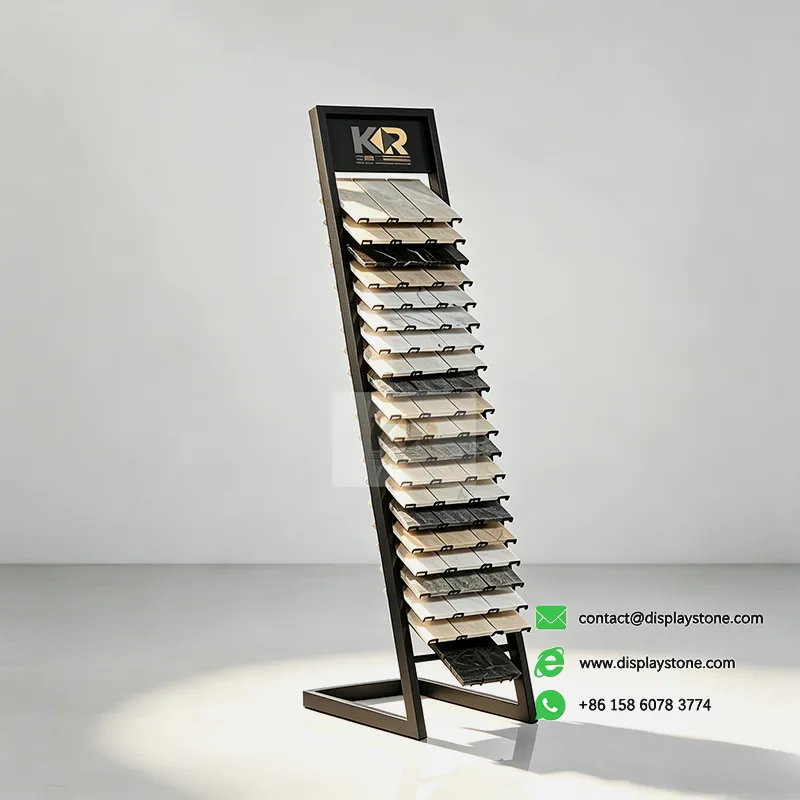
The A-frame stone display tower uses twin A-shaped truss columns rising to 1920 mm on a 395 × 625 mm base, with six tiers on each of two faces — about 24 samples in total. An A-frame stone rack leans boards on both faces, so one unit serves traffic from either side. Each truss is load tested before the finish cures. Balance board weights across both faces so the tower stays neutral.
7. Narrow Stone Sample Tower
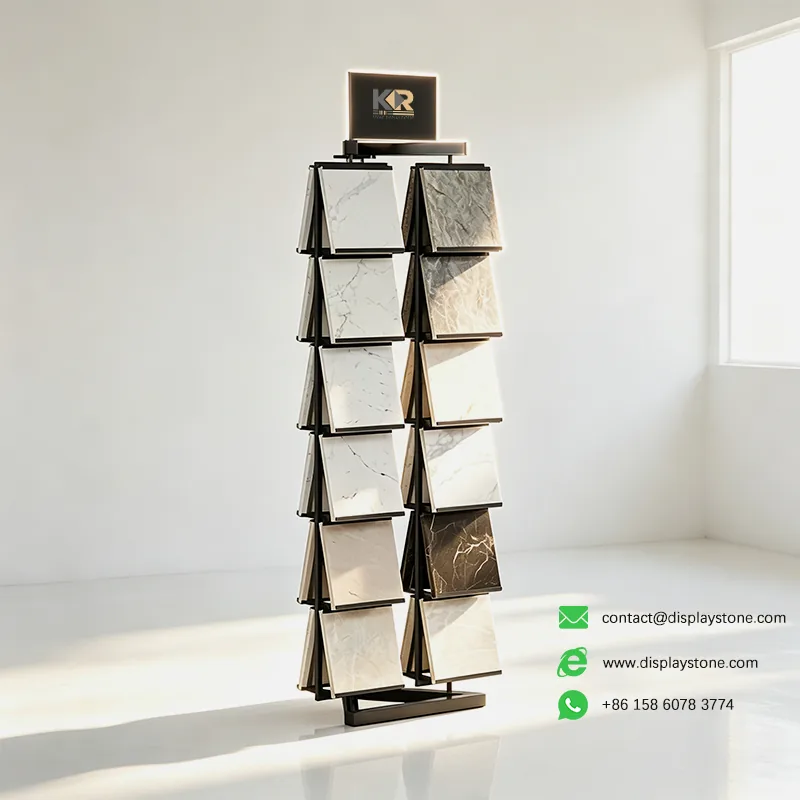
The narrow stone sample tower runs two columns of small shelves up a slim frame at 2000 × 329 × 421 mm, holding about 20 small samples. It trades width for height, so a busy showroom gains capacity without losing walkway. The weighted base means it does not need wall anchoring when loaded evenly, and OEM branding runs from 50 units.
8. Stone Sample Display Rack
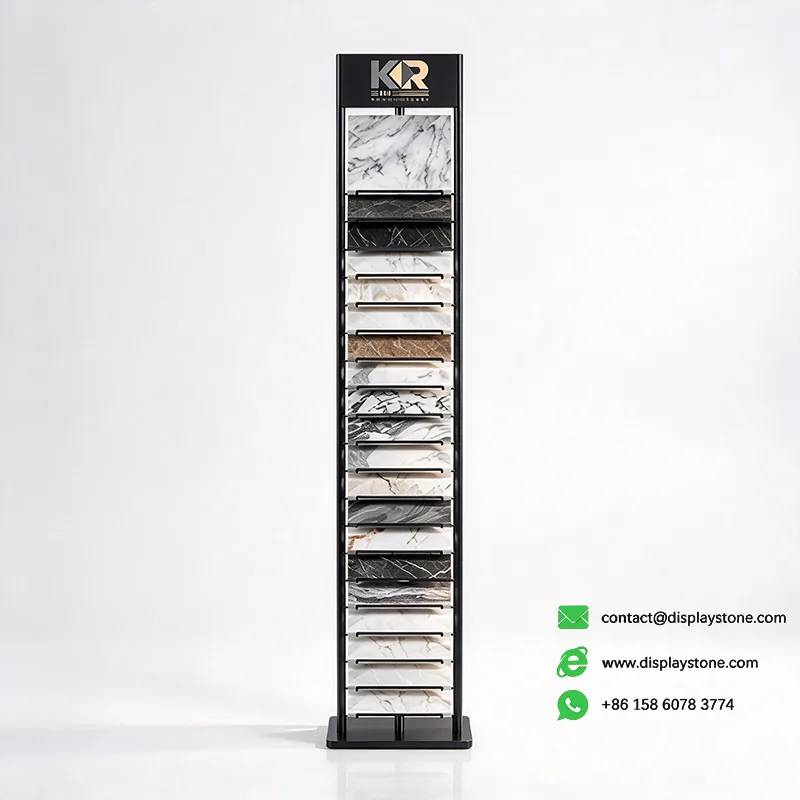
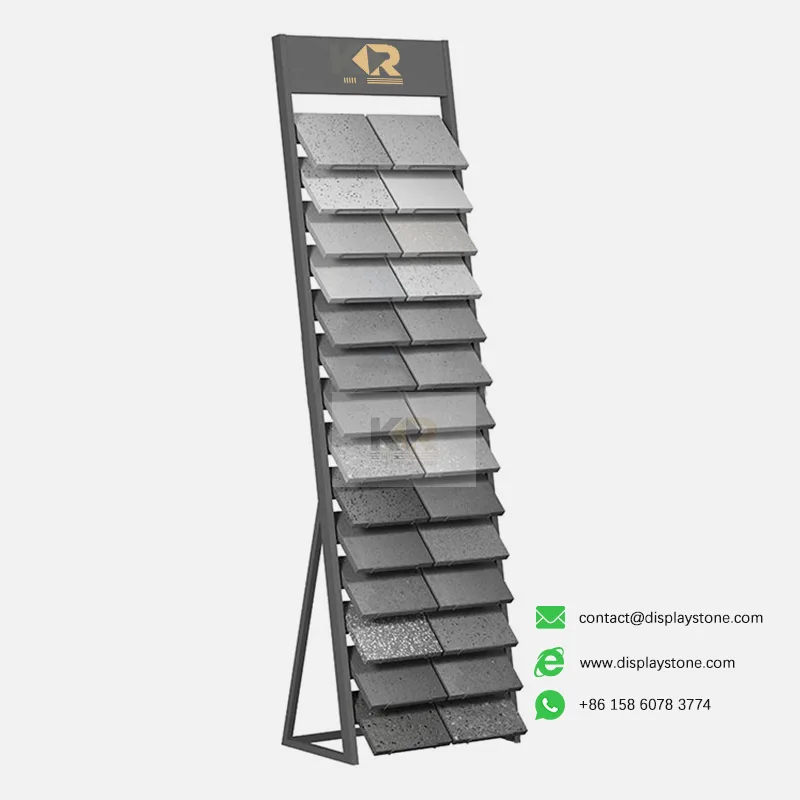
The stone sample display rack is an A-frame multi-tier unit built for cut samples rather than full slabs. It presents 26 finishes at eye level on wire hooks. Pair it with a slab rack when you need to show both large formats and small finishes in the same room.
9. Tabletop Stone Display Rack
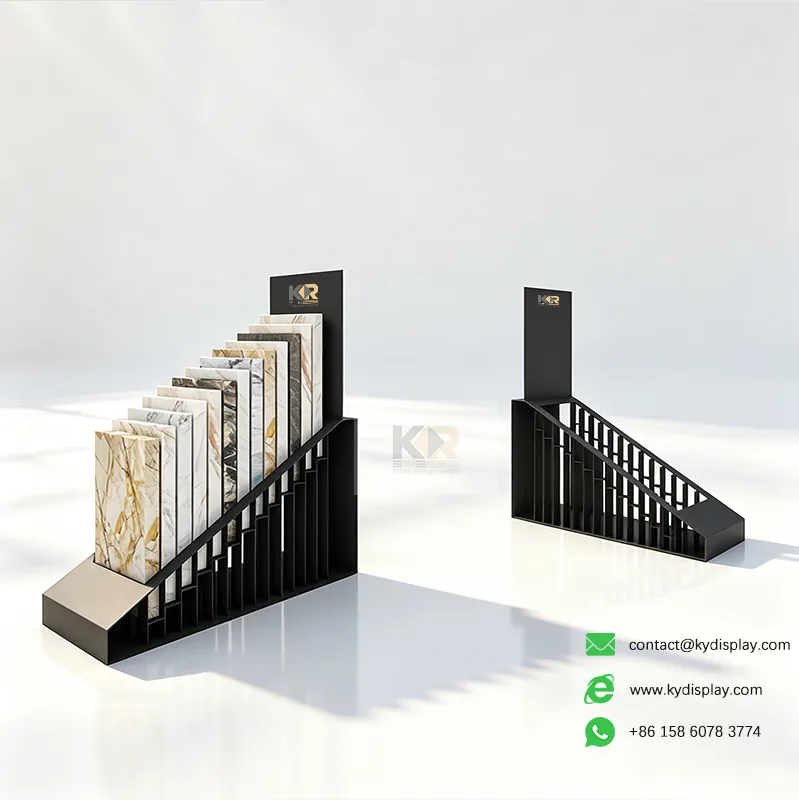
The tabletop stone display rack is a compact slot-type unit at 430 × 360 × 160 mm, holding roughly 9–10 samples depending on thickness. Samples stand in their own slots with an angled face, slot width is adjustable so thick granite and thin porcelain share one stand, and the top header takes your logo. Use it on reception desks, studio tables and trade-show counters.
Comparison Table
| Type | Size (H × W × D, mm) | Capacity | Footprint | Best for |
|---|---|---|---|---|
| Vertical rack | 1952 × 472 × 452 | 15–20 slabs | 0.21 m² | Narrow aisles, full slabs |
| Marble stand | 1992 × 575 × 450 | Custom slots | Compact | Marble, granite, quartz slabs |
| Tower | 2070 × 381 × 640 | 24–28 samples | 0.24 m² | Center island |
| Slanted rack | 1980 × 480 × 460 | 28 samples | 0.22 m² | Design showrooms |
| Slanted 1800 | 1800 × 550 × 360 | Adjustable tiers | Compact | Walls, corners |
| A-frame tower | 1920 × 395 × 625 | ~24 samples | Compact | Two-sided browsing |
| Narrow tower | 2000 × 329 × 421 | ~20 samples | Compact | Slim gaps, grid walls |
| Sample rack | See product page | 26 finishes | Compact | Cut samples |
| Tabletop | 430 × 360 × 160 | ~9–10 samples | Countertop | Desks, trade shows |
Also Available: Rotating, Leaning, Curved and High-Capacity Formats
Beyond the nine above, our range includes sliding, tower and rotating systems, plus a leaning stone display rack, a curved stone display stand, a high-capacity stone display rack and a combination stone display rack. A rotating stone display rack configuration is built to order for showrooms that want buyers to spin through a range from one standing position; send us your sample dimensions and we will confirm the build. For off-site meetings, the folding stone sample book carries 32 sample pockets in a portable binder.
Which Stone Display Rack Type Should You Pick?
Match the format to your heaviest sample and your tightest floor constraint. Full slabs need the vertical rack or marble stand, with 2.0 mm steel. Cut samples and chips are better on the narrow tower, sample rack or tabletop unit. If customers should walk around the display, choose the tower or A-frame tower; if they should read color at eye level from a distance, choose a slanted format.
For the framework behind all nine types, see our complete stone display rack guide. Our four-step selection guide turns that into a decision you can defend, and the full stone display rack category lists current specifications.
If you would rather compare formats in person, most of these types appear on the show floor at Coverings, the largest tile and stone exhibition in North America, and at BAU in Munich, where European material brands present complete showroom systems. Seeing the stone display rack types side by side makes the footprint difference obvious.
Frequently Asked Questions
How many stone display rack types are there?
Nine main formats cover almost every showroom: vertical slab rack, marble stand, tower, slanted rack, slanted vertical rack, A-frame tower, narrow sample tower, sample display rack and tabletop unit. Rotating, leaning, curved, high-capacity and combination variants are also built to order. Matched against your slab size, these stone display rack types make the choice measurable rather than visual.
Which type holds the most stone per square meter?
The tower is the densest in our line, showing 24–28 samples in 0.24 m². The vertical rack shows 15–20 full slabs in 0.21 m², which is the better figure when your samples are full-size slabs rather than cut pieces.
Do all stone display rack types need wall anchoring?
No. Tall units should use a wide base plate plus a wall anchor, but the narrow stone sample tower ships with a weighted base that stays steady when loaded evenly, so it does not require anchoring.
Can one type handle both slabs and small samples?
Not ideally. Slab formats need deep slots and 2.0 mm steel, while chip formats are better on shelves or hooks. Most showrooms pair one slab unit with one sample unit so both formats read cleanly.
Are the dimensions fixed?
No. Height, slot count, tray spacing and frame color are all adjustable to your sample size, and RAL matching plus logo branding are available on OEM orders.