Phone: 0086-15860783774 Email: contact@displaystone.com

Why Most Showrooms Pick the Wrong Stone Display Rack
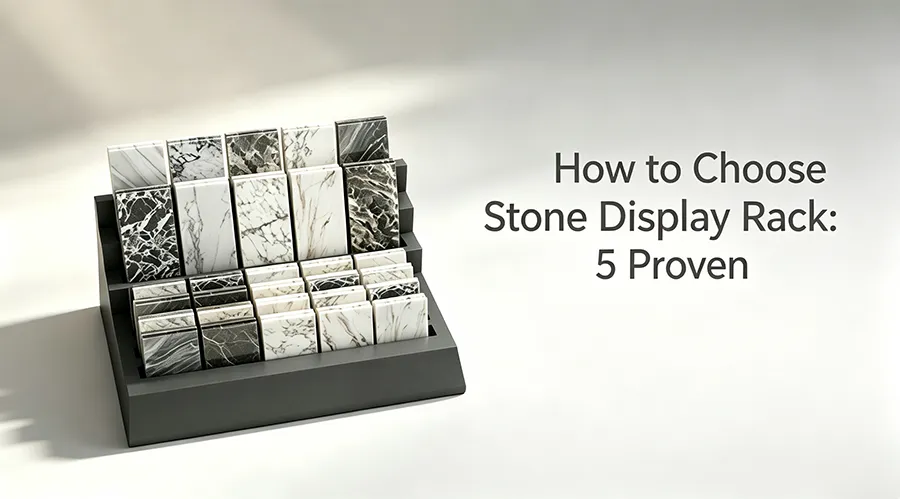
A stone display rack looks like a simple metal frame. However, the wrong stone display rack quietly costs you money every month. First, floor rent is paid by the square meter, so a bulky frame wastes prime space. Next, a poor layout hides your best slabs behind others. Finally, an under-built frame risks tipping and damaging expensive stone.
Therefore, this stone display rack guide does more than list types. As a stone display rack manufacturer, we show you the math behind slab weight, the real specs of five proven styles, a four-step selection framework, and a space-and-ROI check. In short, you will leave with a choice you can defend to your boss and your accountant.
Step 1: Do the Slab Math Before You Shop
Before you compare frames, calculate what your stone display rack must actually hold. This stone display rack for showroom checklist starts with weight, not looks. Specifically, weight decides the steel you need, and size decides the slot depth.
How Much Does a Stone Slab Weigh?
Weight equals density times volume. Granite is about 2.70 g/cm³. Marble is 2.56. Quartz is 2.40. For a common 3000×1500×20 mm slab, the math is simple:
- Granite: 0.09 m³ × 2700 kg = 243 kg
- Marble: 0.09 m³ × 2560 kg = 230 kg
- Quartz: 0.09 m³ × 2400 kg = 216 kg
Consequently, a stone display rack that holds 20 granite slabs carries roughly 4.9 tonnes at once. That load is why frame steel and base design matter more than a low sticker price.
Know Your Slab Sizes
Most showrooms mix formats. Standard slabs run 2400×1200 mm and 3000×1500 mm. Jumbo quartz often reaches 3200×1600 mm. Therefore, measure your tallest and widest slab first, then match the rack slot height and depth to the largest piece you sell.
Step 2: Match the Rack Type to the Job
Each stone display rack style solves a different problem. Below are five styles we build, with real specs from our line.
Vertical Stone Display Rack
Our vertical stone display rack stores slabs on edge in slim steel slots. It stands 1952 mm tall, 472 mm wide, and 452 mm deep, so its floor footprint is only 0.21 m². Moreover, the 2.0 mm steel frame holds 15–20 full slabs safely. Therefore, this stone display rack fits narrow aisles and high-traffic walls where space is tight.
Stone Display Tower
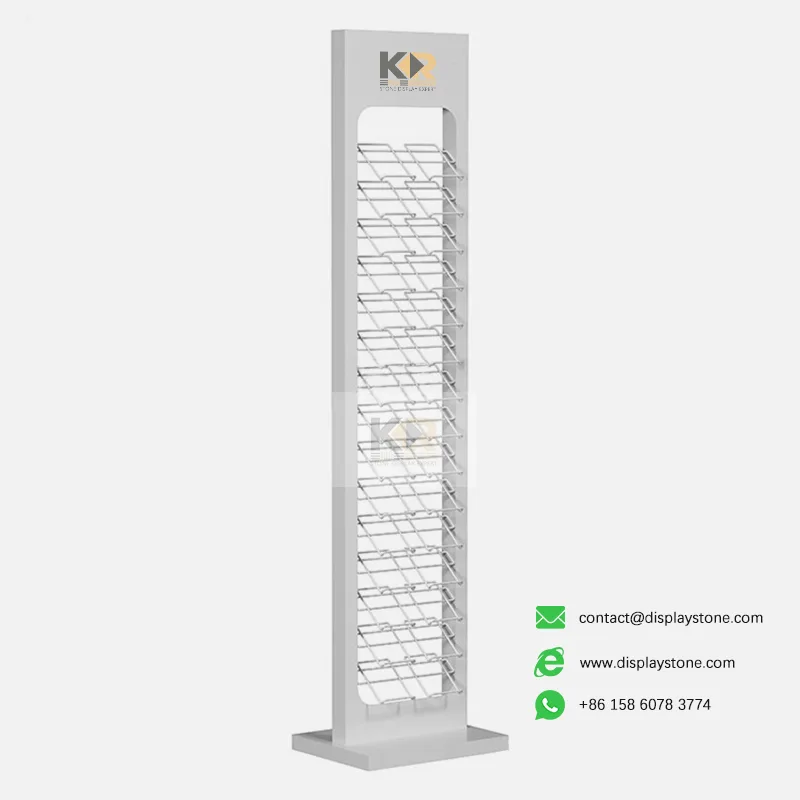
A stone display tower is a double-sided, wire-hook unit. It measures 2070×381×640 mm and holds 24–28 samples in just 0.24 m². Additionally, customers circle it without backtracking, which makes it ideal as a center island. In short, this stone display rack style shows the most stone per square meter of any model here.
Slanted Stone Display Rack
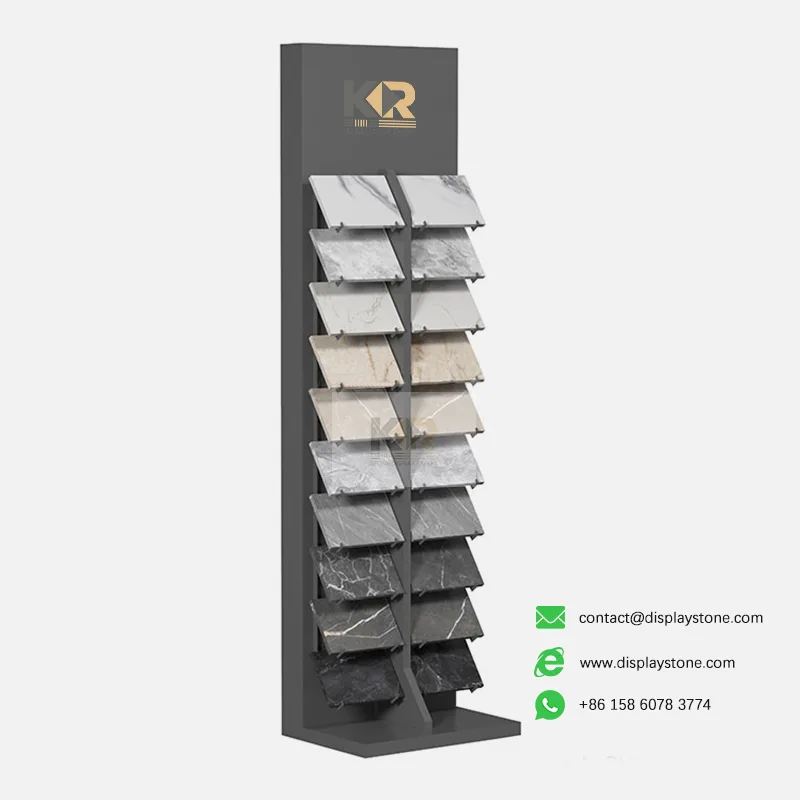
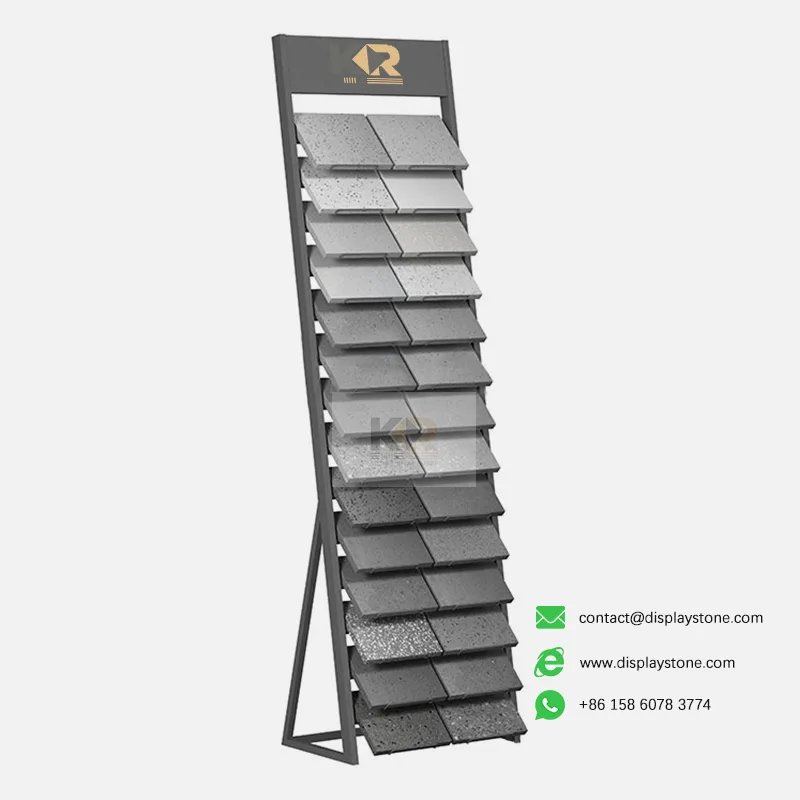
A slanted stone display rack tilts samples toward the viewer at a fixed angle. It stands 1980×480×460 mm, holds 28 samples, and uses 0.22 m². Furthermore, the inclined face cuts glare and shows true color under showroom lights. As a result, this stone display rack suits design-led showrooms that sell on appearance.
Stone Sample Display Rack
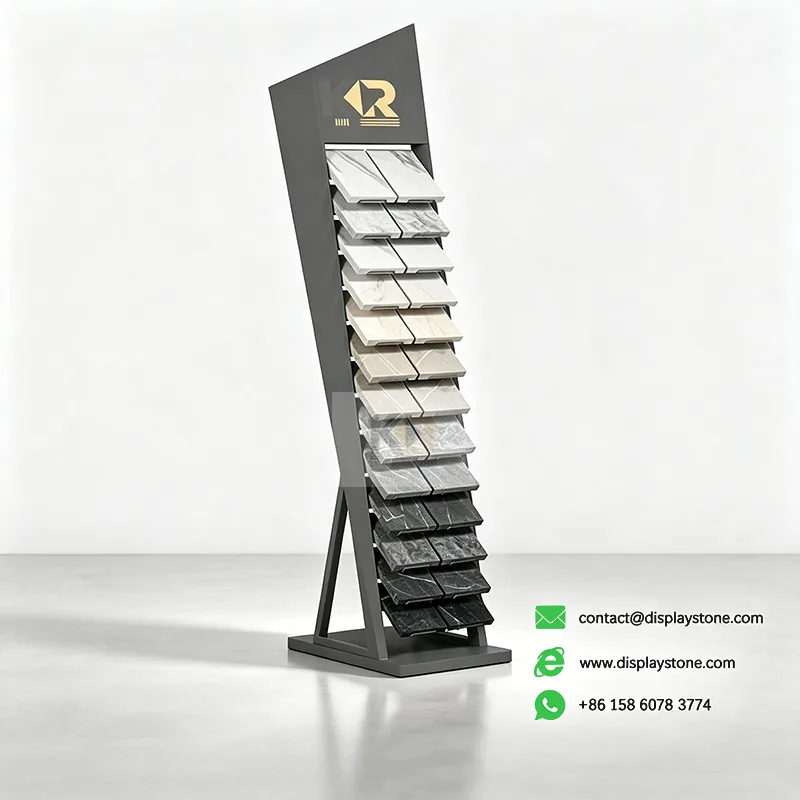
This stone sample display rack is an A-frame, multi-tier unit for cut samples rather than full slabs. It presents 26 finishes at eye level on wire hooks. Therefore, pair it with a slab rack when you must show both large and small formats together.
Folding Stone Sample Book
A folding stone sample book is a portable, hard-cover binder with 32 sample pockets. However, unlike a floor stone display rack, it is a take-to-meeting tool. Nevertheless, it extends your showroom to the client’s office and protects samples in transit.

Step 3: Compare the Real Numbers
Use this table to compare any stone display rack on your shortlist quickly:
| Type | Footprint | Capacity | Best for |
|---|---|---|---|
| Vertical rack | 0.21 m² | 15–20 slabs | Narrow aisles, full slabs |
| Tower | 0.24 m² | 24–28 samples | Center island, browsing |
| Slanted rack | 0.22 m² | 28 samples | Eye-level, design showrooms |
| Sample rack | Compact | 26 samples | Cut samples, finishes |
| Sample book | None | 32 pockets | Off-site meetings |
Step 4: Check Build Quality and Safety
A cheap stone display rack fails where it matters. Therefore, inspect these points before you buy:
- Steel thickness: choose at least 2.0 mm for full slabs; thin tube bends under load.
- Base and anchor: a wide base plate plus wall anchor stops tipping.
- Coating: powder coat resists chips and rust better than paint.
- Welds: continuous welds beat spot welds for long-term strength.
- Load rating: an honest rating beats a vague “heavy duty” claim.
Space and ROI: How Many Racks Fit Your Floor?
A good stone display rack pays rent back. For example, a slab laid flat needs about 4.5 m² of floor. In contrast, a vertical stone display rack shows 15–20 slabs in 0.21 m². That is roughly 20–50 times more space-efficient than flat stacking. Meanwhile, a 40 m² showroom can display 150–300 slabs along its walls while keeping the center open for customers. Therefore, the right rack lowers rent per displayed sample and speeds up buying decisions.
Lighting and Color Accuracy
Stone sells on color, so pair your stone display rack with the right light. First, use LEDs with a CRI of 90 or higher and a temperature near 4000–5000K for true color. Next, choose inclined racks because they present the surface at a natural angle and cut glare. Consequently, customers see the real veining instead of a reflection, which builds trust and shortens the sale.
Match the Stone Display Rack to Your Showroom Type
Different buyers need different systems:
- Distributor or importer: combine vertical racks, a tower, and a sample book to show volume and carry a catalog to meetings.
- Fabricator: place vertical slot racks near the cutting area for daily slab handling and fast pickup.
- Designer showroom: lead with slanted and sample racks where looks drive the sale.
The same rules apply if you need a marble display stand or a tile display rack—weight and slot size still decide the build.
Common Mistakes to Avoid
- Buying on price alone—a weak stone display rack bends and scratches stone.
- Ignoring slab weight—overloaded slots are a safety risk.
- Mixing too many styles—visual clutter hurts the brand.
- Skipping wall anchors—tall racks can tip.
- Forgetting future growth—leave room to add samples.
- Using flat stacking—it wastes floor and hides inventory.
A Note for Importers and OEM Buyers
We manufacture these racks and support OEM/ODM. Specifically, we build your stone display rack to your gauge, size, finish, and branding. Additionally, we help plan container loads so a full range ships efficiently. For sister solutions and tile-focused displays, visit KYdisplay.
Frequently Asked Questions
How many slabs can a stone display rack hold?
It depends on the style. A vertical rack holds 15–20 full slabs. A tower holds 24–28 samples. A slanted rack holds 28. Choose by slab size and traffic, not by looks alone.
What steel thickness do I need for granite slabs?
Use at least 2.0 mm steel for full granite slabs. A single 20 mm granite slab weighs about 243 kg, so your stone display rack frame must carry several tonnes without flexing.
Vertical or tower—which saves more floor space?
The tower is densest, showing 24–28 samples in 0.24 m². The vertical rack shows 15–20 slabs in 0.21 m². Pick the tower for a center island and the vertical rack for walls.
How much does a 20 mm granite slab weigh?
About 243 kg at 3000×1500 mm. Marble is close at 230 kg, and quartz is 216 kg for the same size.
How do I stop a display rack from tipping?
Anchor it to the wall, use a wide base plate, load slots evenly, and train staff to pull from the center first. Never overload past the rated count.
Can I order custom or branded racks?
Yes. As the manufacturer, we build to your gauge, size, finish, and logo, and we plan container loads for overseas buyers.
Final Checklist
Choose a stone display rack with this short list: (1) know your slab weight and size, (2) pick the type by job, (3) verify steel, base, and anchor, (4) plan the floor layout. Additionally, browse the full range in our Stone Display Rack category. If you also display tile, see the tile display rack line, which shares the same steel system. In conclusion, the right rack turns stone into sales while protecting your floor, your stock, and your brand.