Phone: 0086-15860783774 Email: contact@displaystone.com

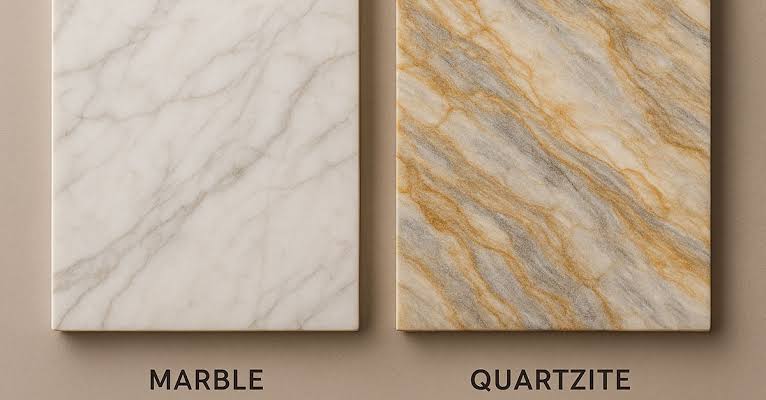
Marble and quartzite sit side by side in most stone showrooms, yet they behave very differently once they leave the slab and land on a display. Picking the right marble display rack — and the right rack for quartzite — changes how safe, how attractive, and how easy to sell your samples become.
This guide compares the two stones as display subjects and maps each one to the rack type that shows it best.
On this page
- Know Your Stone Before You Choose a Rack
- Marble Display Rack: Built for a Soft, Porous Stone
- Quartzite Display Rack: Built for a Hard, Heavy Stone
- Granite: The Heavyweight in the Mix
- Match the Rack Type to the Stone
- Marble Display Rack Setup Tips That Sell
- Three Display Mistakes to Avoid
- Frequently Asked Questions
Know Your Stone Before You Choose a Rack
Marble and quartzite are both natural stone, and both look elegant in a showroom. Under the surface they differ in three ways that decide rack design: hardness, porosity, and weight per panel. Marble is a recrystallized limestone, soft and calcium-rich. Quartzite is sandstone fused by heat and pressure, so it is far harder and denser.
A rack chosen for one stone may strain or scratch the other if the two are mixed without thought. Therefore, a marble display rack and a quartzite rack should never share the same untuned frame. The difference is easy to measure. For example, on the Mohs scale marble sits around 3–5, quartzite near 7, and granite about 6–7. Those numbers drive every rack decision.
The softer the stone, the gentler the support and the more careful the finish. The harder and heavier the stone, the stronger the frame must be. When you plan a floor, start from the stone, then pick the fixture. Therefore, the smart move is to group samples by stone type, then give each group a rack built for its behavior.
Below we break down what each stone asks of the fixture that holds it.
Marble Display Rack: Built for a Soft, Porous Stone
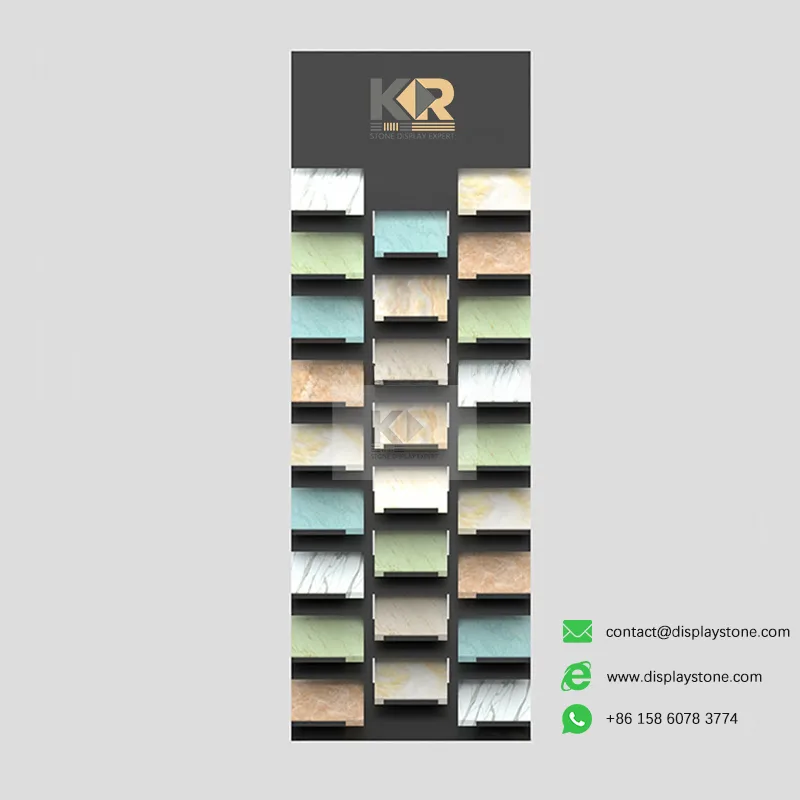
Marble is beautiful and forgiving to cut, but it is also the most delicate stone you will display. A proper marble display rack protects that softness instead of fighting it.
Weight and Support
Marble weighs less than granite but more than quartz surfacing, and a full board still needs real support. The contact points matter most: hard metal edges can chip a polished marble face on every slide. Use pads made from EPDM rubber or felt so the stone rests on a surface that will not stain or scratch light Calacatta or Carrara.
Our vertical marble display stand uses covered contact rails for exactly this reason.
Finish and Viewing Angle
Marble shows best when the face tilts toward the viewer. A marble display rack with a slanted tray lets the vein pattern read at the angle a client naturally stands, so the stone looks rich rather than flat. Honed marble needs softer, wider light because it scatters reflection; polished marble prefers a steeper angle that catches the specular highlight. A tilt of about 15–20 degrees suits most marble samples.
Etching and Surface Care
Marble is calcium carbonate, so it etches on contact with acid. Showroom cleaners, citrus, and even some client hand creams can dull a polished face left on the rack. Wipe boards weekly with a neutral cleaner, keep acidic sprays away from the display, and seal honed marble before it goes on show. A clean marble display rack keeps the sample representative of the slab the client will buy.
Quartzite Display Rack: Built for a Hard, Heavy Stone
Quartzite is the opposite engineering problem. It is one of the hardest natural stones you will display, so the rack must hold serious weight and resist the slab’s own mass without bending. A frame sized only for marble would bow under quartzite’s load.
Load and Frame Strength
Quartzite is denser than marble and noticeably heavier per square foot. The frame needs thicker steel and a lower center of gravity so a fully loaded column stays put. Reinforced lower tiers help most, because that is where the heaviest boards sit. A rack built with light tubing may flex under quartzite, so size the frame to the heavier stone if you plan to mix them.
Slot and Clamp Design
Because quartzite resists scratching, you can use firmer slots and light clamping that would risk a marble edge. Fixed dividers and tool-free brackets keep heavy boards secure while staff swap samples. The slanted vertical stone display rack carries both, but a marble display rack still needs the gentler pads even when placed beside it.
For pure quartzite a reinforced vertical or A-frame layout spreads the load best and saves floor space.
Granite: The Heavyweight in the Mix
Granite rounds out the trio. It is dense and heavy, close to quartzite in load but more uniform in color. Granite tolerates rougher handling, so a simple slotted rack works, yet the frame must still be rated for the weight. If your showroom shows granite next to marble, keep granite on the lower, strongest tiers and marble on the gentler upper rows.
Granite in Daily Use
Granite also hides dust and fingerprints better than pale marble, which means it can sit longer between wipes. Use that trait to place granite where traffic is highest and marble where lighting and care show it best. The same slotted frame that holds granite will hold quartzite, but marble needs the padded, slanted treatment described above.
Match the Rack Type to the Stone
The quick rule: match softness to gentleness and weight to frame strength. Use this mapping when you plan the floor.
- Marble → slanted or tilted sample racks with rubber-lined pads, gentle tilt, sealed finish. A dedicated marble display rack protects the soft face.
- Quartzite → reinforced vertical, A-frame, or slot racks with a low, heavy base. Firm dividers are safe here.
- Granite → strong slotted racks, heaviest tiers at the bottom, simple dividers.
- Mixed displays → separate by stone, or size every tier to the heaviest stone you place on it.
For high-capacity quartzite and granite walls, the stone display tower holds many boards in a small footprint. Also, for marble, pick a display rack such as the slanted stone display rack keeps faces visible and safe.
Sample Size and Pitch
Sample size also guides the layout. First, note that most showrooms use 5″ × 10″, 12″ × 12″, or 300 × 300 mm boards. Marble boards are often thinner and lighter, so a tighter tray pitch fits more of them. Quartzite and granite boards are heavier, so widen the pitch and lower the count per tier. Match pitch to the heaviest board you actually place, not to the lightest.
Marble Display Rack Setup Tips That Sell
Even the best rack underperforms with poor setup. A few habits lift both marble and quartzite presentation:
- Light it warm and even. Around 4000–5000K LED at a 30-degree angle makes marble veins pop and reads true on quartzite. Avoid harsh top-down spots that flatten the face.
- Group by color and origin. Place Carrara near Calacatta, and keep quartzite separate so clients compare like with like. Grouping also exposes the fixture as an organized system, not a pile.
- Label every board. Stone name, finish, and origin on a small card turns a sample into a confident choice. Clear signs also reduce staff Questions during busy hours.
- Add your logo. A branded top panel turns a generic fixture into a memorable one, useful when clients photograph the showroom.
Also, for related care and sample grouping ideas, see our travertine sample display guide, since travertine shares marble’s porous, acid-sensitive nature and benefits from the same gentle handling.
Three Display Mistakes to Avoid
Even with the right fixture, a few habits undercut a stone display. Avoid these three:
- Mixing stones on one soft rack. One gentle rack cannot safely hold quartzite. Size every tier to the heaviest stone, or keep stone groups on separate fixtures.
- Top-down spotlights. Light from straight above flattens marble veins and hides quartzite depth. Angle the source about 30 degrees to the face instead.
- Skipping the seal. Honed marble left unsealed on the rack picks up etching and fingerprints fast. Seal before show and wipe with a neutral cleaner weekly.
Frequently Asked Questions
Can one rack hold both marble and quartzite?
Yes, but size every tier to the heavier stone. Quartzite is denser and can stress a frame built only for marble, so use reinforced steel and rubber pads so the softer marble still rests safely.
What tilt angle is best for a marble display rack?
For a marble display rack, a tilt near 15–20 degrees shows the marble face at a natural standing angle. Polished marble can take a slightly steeper tilt to catch light, while honed marble prefers a gentler lean with softer lighting.
How many samples fit in a marble display rack?
It depends on tray pitch and board size, yet most slanted marble display racks hold 12–24 boards. Leave one empty slot between colors so clients can lift a sample without scraping its neighbor.
Does marble etch while on the rack?
It can, if acid touches the face. So keep citrus, acidic cleaners, and vinegar away from the display, wipe boards weekly with a neutral cloth, and seal honed marble before show. A clean rack prevents most etching.
Should I use a slanted or vertical marble display rack?
For showrooms, a slanted marble display rack wins: the tilt shows the vein at eye level and protects the soft edge. A vertical rack saves space but needs careful pads and is better for harder stones like quartzite. So choosing the right fixture is not decoration. The correct rack keeps a soft stone safe and beautiful, while a quartzite-rated frame carries real weight without flex.
Match the rack to the stone, and your samples will sell themselves. For OEM and ODM rack design sized to your exact samples, contact our team for a drawing and quote. For stone care standards and showroom handling guidance, see the Natural Stone Institute.